What Size Dumpster Do I Actually Need? A Concord Homeowner's Guide
Almost every sizing mistake we see comes from the same place: people estimate volume and forget weight. Here is how to get it right the first time.
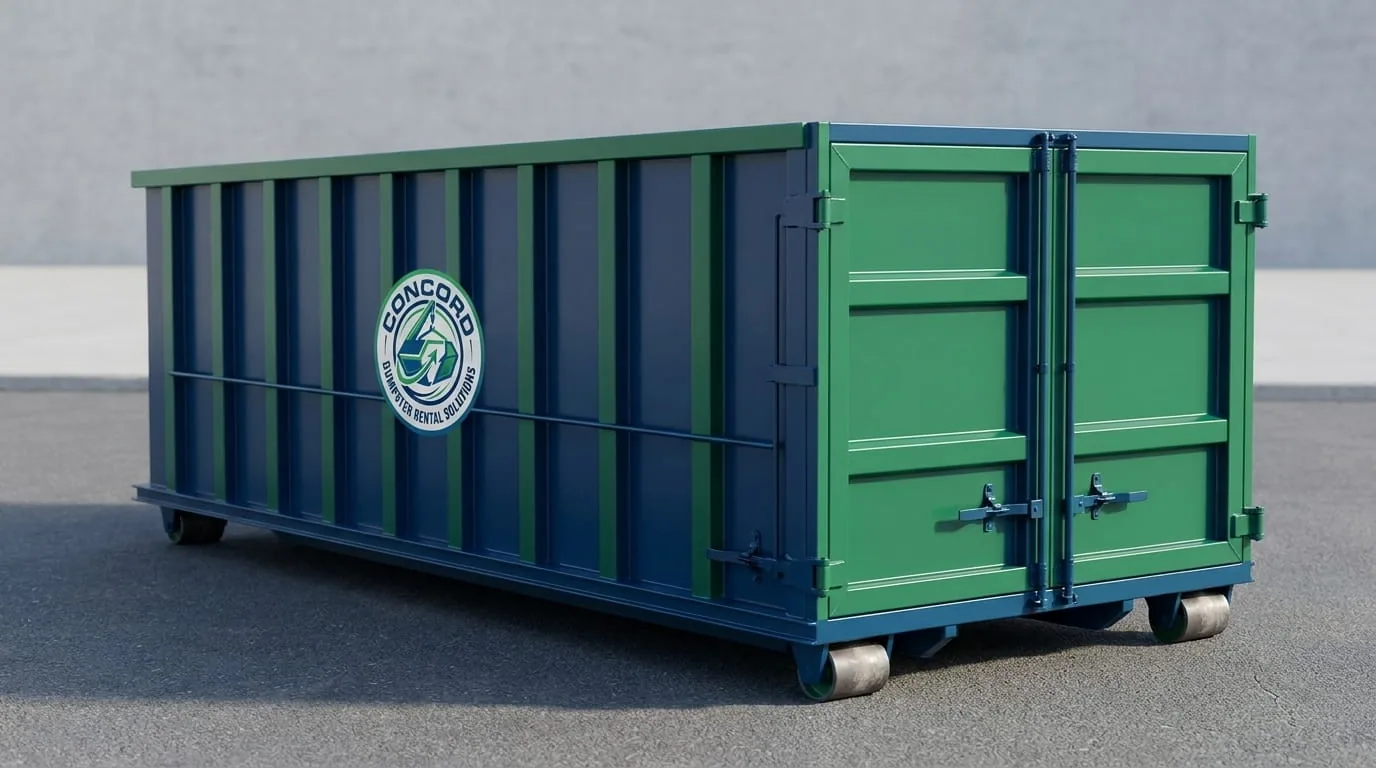
In fourteen years of taking sizing calls in Concord, the single most common mistake has never changed. People estimate how much stuff they have, mentally picture a container that would hold it, and order that. Volume is genuinely half the answer. The other half is weight, and getting it wrong is the difference between one container that works and two deliveries you did not budget for.
The question that actually matters
Before anything else, sort your debris into one of two categories.
Dense material includes plaster, wood lath, ceramic and porcelain tile, concrete, brick, block, asphalt, soil, stone, roofing shingles and old hardwood or tile flooring set in mortar. A cubic yard of this material weighs anywhere from 1,200 pounds up to about 4,000 pounds for solid concrete.
Bulky material includes furniture, mattresses, carpet, drywall, insulation, framing offcuts, sheathing, cabinetry, packaging, plastics and general household clutter. A cubic yard of this weighs somewhere between 100 and 400 pounds.
That is a spread of roughly ten to one. A 20 yard container filled with bulky household contents might weigh two tons. The same container filled with plaster and lath will be well past four tons and heading for a weight problem. It is the same box.
Every roll-off has a tonnage allowance built into its price and a legal road weight it cannot exceed regardless of what you paid. Dense material hits both of those limits long before the walls fill. That is why the correct container for a heavy job is frequently smaller than the one you would instinctively pick.
Why Concord's housing stock changes the answer
This matters more here than it does in a lot of American cities, because of when Concord was built.
A very large share of the housing through the South End, the North End, East Concord, West Concord and Penacook predates the widespread use of gypsum wallboard. Those homes have plaster applied over wood lath, board sheathing rather than plywood, and full-dimension lumber. When you take a wall out in a 1912 house on School Street, what comes down is dense, dusty and heavy, and it settles as it loads. Customers regularly tell us their container looked half empty when it was already at its allowance. It was.
The newer construction that filled in through the 1980s, 90s and 2000s — the Broken Ground area, much of the Heights, the developments out along Sheep Davis Road and over the line in Bow — behaves the opposite way. Drywall, engineered lumber, vinyl siding, fibreglass insulation and modern packaging are voluminous and light. Order a container that is too small for that work and you will be calling for a swap you did not need to pay for.
So the first question we ask on the phone is not how big the project is. It is roughly when the building went up.
A size-by-size breakdown
10 yard
Roughly 12 feet long, 8 wide and 3.5 high. About three pickup loads. Its footprint fits a single-car driveway with room to walk past.
This is the heavy-material container. Concrete, brick, tile, soil and small roof tear-offs belong here. It also suits a single bathroom remodel or a one-room clear-out. If you are filling it with household contents you will run out of room fast, and that is a sign you needed a different size.
15 yard
About 14 feet long with roughly 4.5 foot walls. Four to five pickup loads.
This is the container we recommend more than any other in Concord, and the reason is that plaster-and-lath demolition sits right in the band where a 15 fills up and weighs out at about the same moment. It is also the right size for garage, basement and attic cleanouts, single-room renovations including flooring, and deck removal. The lower walls make it easy to load by hand.
20 yard
Around 22 feet long with the same 4.5 foot walls as a 15. Six pickup loads.
The most versatile size in the range and the most commonly ordered nationally. It handles a kitchen and a bathroom together, a whole floor of flooring replacement, a large garage or basement clear-out, and general remodel debris from a newer home. It is not the right home for meaningful quantities of concrete or tile.
30 yard
Same 22 foot footprint as the 20 but with 6 foot walls. Nine pickup loads.
The extra capacity comes entirely from height, which means it needs no more driveway than a 20 yard does. That makes it excellent value for bulky material: whole-house and estate cleanouts, additions, camp clear-outs, commercial fit-outs and outbuilding demolition. Six-foot walls do make hand loading harder, so use the rear swing door.
40 yard
Same length again, 8 foot walls. Twelve pickup loads.
A commercial and large-construction container. On a site producing continuous light waste, its real value is not the disposal cost but the reduced number of swaps interrupting the crew. It rarely suits a residential driveway, and it should never see heavy material.
Project-by-project guidance
- Single bathroom remodel: 10 yard. Tile and a cast-iron tub are heavy.
- Kitchen remodel: 20 yard. Add a bathroom and it still fits.
- Garage or basement cleanout: 15 yard, or a 20 if it is packed with stored building materials.
- Whole-house cleanout, three bedrooms: 30 yard, occasionally with one swap if there is a full basement or barn.
- Roof tear-off: Sized by weight, not volume. Up to about 20 squares single-layer suits a 15 or 20. Multiple layers need a bigger tonnage allowance rather than a bigger box. More on roofing here.
- Deck removal: 15 yard for a typical rear deck. Pressure-treated lumber is heavier than it looks.
- Driveway or patio concrete: 10 yard, dedicated clean fill, and it will look barely used when it is legally full. This page explains why.
- Room addition: 30 yard for the framing and exterior phases.
- Estate cleanout: 30 yard with an extended rental period. Approach it slowly.
- Commercial fit-out: 30 or 40 yard with scheduled swaps.
The access check people skip
The container length is almost never the constraint. The truck is.
To set a container down and pick it back up, a roll-off truck needs a straight approach of roughly 45 to 55 feet for a 10 yard, 50 to 60 for a 15, and 60 to 70 for a 20 or 30. It needs about 11 to 12 feet of width at the narrowest point. And critically, it needs around 23 feet of vertical clearance at the moment the container is raised.
That overhead figure stops more Concord deliveries than anything else. A mature maple over a driveway in the North End, a service drop to the house, a carport, a low garage overhang — all of them are fine for a car and impossible for a raised roll-off. Walk the route and look up before you book.
Ground conditions are the other one, particularly in the outer towns. Gravel handles the load well once compacted. Saturated ground in March and April does not, and we would far rather set a container at the top of a Dunbarton or Canterbury driveway than leave ruts you will be filling all summer.
When to round up and when to round down
If you are between two sizes and the material is bulky, take the larger container. A second delivery always costs more than the price difference between two sizes.
If you are between two sizes and the material is dense, take the smaller one. The larger container will reach its weight allowance before you can use the extra volume, so you would be paying for capacity you are not legally allowed to fill.
And if you genuinely cannot tell, call. Tell us when the house was built, what is coming out and what the driveway looks like. It takes ninety seconds and we do it a dozen times a day. We will occasionally talk you into something cheaper than what you asked for, which is the whole point.
Frequently asked questions
What is the most common dumpster size for a home project?
The 20 yard, by a comfortable margin. It handles most single-room and multi-room renovation work in one container. In Concord specifically we recommend the 15 yard almost as often, because plaster-and-lath demolition from older homes weighs out before a 20 fills up.
Is it cheaper to get one large dumpster or two small ones?
One large container is nearly always cheaper for bulky material, because each delivery carries its own cost. For heavy material the calculation reverses, since a large container cannot legally be filled and you end up paying for volume you cannot use.
How do I estimate how much debris I have?
Count pickup truck loads. A 10 yard is about three, a 15 about four to five, a 20 about six, a 30 about nine and a 40 about twelve. Then adjust for weight: if the material is dense, drop a size and expect to fill it properly.
What happens if I order the wrong size?
Call us. If we can swap it before you have loaded much, we will. If you have already filled it and need a second, we will get one out. Neither is a disaster, but both cost more than getting it right on the phone in the first place.
Questions about your own project?
We will give you a straight answer on sizing and a flat rate on the phone, whether or not you book with us.
(888) 921-1635